
Mauritius rewards the prepared traveller. The island is compact enough to cross in two hours yet varied enough to occupy two weeks without repetition, provided you know where to look. Whether you are arriving for a holiday or weighing up a longer stay, this guide covers the experiences and practical steps that define a genuine engagement with the island.
Spend Time on the East Coast Lagoon
The east coast lagoon is the quietest argument for staying longer than you planned, reef-protected, impossibly clear, and lined with resorts that have quietly set the standard for Indian Ocean hospitality. Belle Mare and Palmar offer the longest uninterrupted stretch of white sand on the island. Arrive early, walk south from the public beach access, and you will have most of it to yourself before 9 a.m.
The reef here is close enough to reach by kayak. Snorkelling directly off the beach reveals parrotfish, moray eels, and occasional sea turtles without the need for a boat charter.
Drive the South Coast
The south is different: wilder, less visited, and worth every kilometre of the drive. The coastal road between Souillac and Le Morne passes blowholes at Gris Gris, the dramatic cliffs at Rochester Falls, and the dark sand beach at Gris Gris, none of which appear in most holiday brochures. The drive takes a full day done properly, with stops.
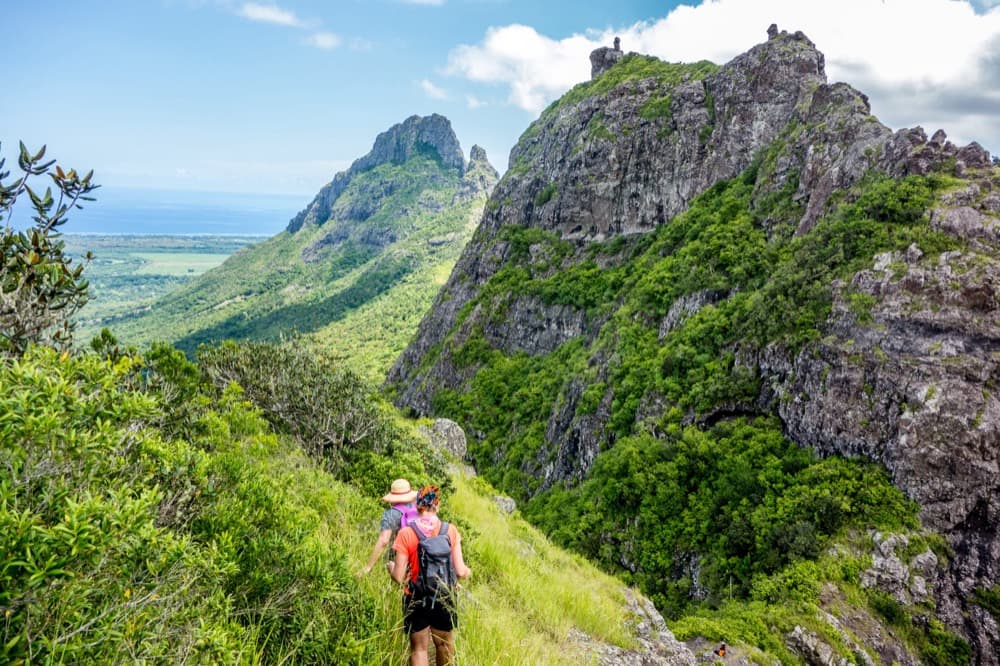
Le Morne Brabant, the basalt monolith at the southwestern tip, carries significant historical weight as a UNESCO World Heritage Site, a refuge for escaped enslaved people in the eighteenth century. Hiking to the summit takes around two hours and offers a clear view of the lagoon gradient from turquoise to deep navy.
Eat at a Table d'Hôte
Mauritius has a restaurant culture that leans heavily on Creole, Indian, and Chinese influences, often within the same meal. A table d'hôte, a home-hosted dinner, typically booked in advance, is the most direct way to experience this. Hosts in the north around Grand Baie and in the central plateau villages around Curepipe both offer versions of this. Expect rougaille, dholl puri, and slow-cooked curries that bear no resemblance to anything served in an airport hotel.
Visit the Central Market in Port Louis
Port Louis is the commercial and administrative capital of Mauritius. Its central market is a functional, working market, not a tourist reconstruction, where vendors sell spices, street food, and textiles side by side. The upper floor is quieter and better for browsing. The surrounding Caudan Waterfront area offers a contrast: modern retail and banking services within walking distance.
Port Louis is also where most of the island's financial infrastructure is concentrated, which matters if you are considering a longer stay.
Understand the Financial Infrastructure if You Are Relocating
For internationally mobile professionals and families considering Mauritius as a base, the banking system is a practical priority. The Mauritius Commercial Bank (MCB) is the largest commercial bank on the island and one of the most established financial institutions in sub-Saharan Africa and the Indian Ocean region. MCB offers internet banking services, known locally as internet banking MCB Mauritius or internet banking Mauritius Commercial Bank, that allow account holders to manage transfers, pay bills, and access statements remotely.
Setting up a local bank account early simplifies everything from paying rent to receiving a salary. MCB's online platform supports multi-currency accounts, which is relevant for those earning in foreign currencies while living on the island. Other major banks operating in Mauritius include SBM (State Bank of Mauritius) and Absa Mauritius, each with their own digital banking portals.
Explore Job Opportunities in Mauritius
Mauritius has actively positioned itself as a regional business hub, and career opportunities in Mauritius span several sectors. The island's economy is anchored in financial services, tourism, ICT (information and communication technology), and a growing business process outsourcing (BPO) sector.
Where to Find Jobs in Mauritius
For those researching jobs in Mauritius, the primary platforms include:
- MyJob.mu, the dominant local job board, covering everything from entry-level roles to senior management positions across all sectors
- LinkedIn, increasingly used by multinational companies with Mauritius operations for professional hiring
- Government portals, the Ministry of Labour publishes vacancy listings for public sector roles
- Direct company applications, large employers such as MCB, Rogers Group, IBL Group, and ENL Group post vacancies on their own career pages
Mauritius job opportunities are particularly strong in fintech and financial services, driven by the island's status as an international financial centre. The Global Business sector, which handles cross-border investment structures, employs a significant number of qualified accountants, lawyers, and compliance professionals.
Career Opportunities in Mauritius for Expatriates
The government's Occupation Permit system allows foreign nationals to work legally in Mauritius under three categories: investor, professional, and self-employed. The professional permit requires a minimum annual salary threshold (reviewed periodically by the Economic Development Board). Processing times are generally efficient by regional standards.
For those already employed abroad, remote work arrangements are increasingly common, and Mauritius introduced a Premium Visa in 2020 specifically for remote workers and retirees wishing to stay for up to one year.
Take the Train, Or What Replaced It
Mauritius decommissioned its railway in 1964. What replaced it is a network of buses that covers the island comprehensively and cheaply. The Metro Express light rail, opened in 2019, now connects Rose Hill to Port Louis and is being extended toward Curepipe. For daily commuters and visitors wanting to avoid traffic on the central plateau corridor, it is a practical option and costs a fraction of a taxi.
Go Kitesurfing at Le Morne or Anse La Raie
The trade winds that cross Mauritius between May and November make the island one of the most consistent kitesurfing destinations in the Indian Ocean. Le Morne on the southwest tip and Anse La Raie on the north coast are the two main spots. Le Morne is better suited to experienced riders; Anse La Raie's shallower, calmer lagoon is where most schools run beginner lessons.
If kitesurfing is not your discipline, the same wind season is ideal for sailing, windsurfing, and deep-sea fishing charters out of Grand Baie.
Visit Île aux Cerfs and Île aux Aigrettes
These two islands represent opposite ends of the Mauritius experience. Île aux Cerfs, off the east coast near Trou d'Eau Douce, is a popular day-trip destination with calm water, beach bars, and water sports. It is busy on weekends; visit midweek if possible.
Île aux Aigrettes, a coral island off the southeast coast near Mahébourg, is a conservation project managed by the Mauritian Wildlife Foundation. It has been partially restored to its pre-human ecological state, with giant Aldabra tortoises, endemic birds, and guided tours that put the island's natural history in clear context. The contrast with Île aux Cerfs, a few kilometres away, is instructive.
Plan Around the Seasons
Mauritius has two seasons: a warm, humid summer from November to April (cyclone season falls within this window, typically January to March) and a cooler, drier winter from May to October. The east coast is windier in winter; the west coast is calmer. The south is worth visiting year-round but is most dramatic after heavy rain when the waterfalls are running.
For those considering relocation, the winter months offer the most comfortable conditions for exploring the island before committing to a neighbourhood.
Between the east coast lagoon and the southern cliffs, the financial centre in Port Louis and the kitesurfing flats at Le Morne, Mauritius covers more ground than its size suggests. The must do things in Mauritius are not a checklist, they are an argument for staying longer and looking more carefully.