

Lost Forever
The Dodo
The most famous extinct animal in the world — and why its story still matters.
The dodo is the national symbol of Mauritius. It is also the world's most famous extinct animal — the creature whose fate gave us the expression “dead as a dodo” and which has come to represent, centuries before the modern conservation movement, the irreversible cost of human carelessness.
Raphus cucullatus was a large, flightless bird found nowhere else on earth. It lived peacefully on Mauritius for millions of years. Within less than 80 years of the first Dutch landing in 1598, it was gone forever.
Reconstruction
What the Dodo Actually Looked Like
The dodo was never photographed — only sketched by Dutch sailors and painted by a handful of European artists who had seen living specimens. Modern natural historians have used skeletal data, feather fragments, and eyewitness accounts to reconstruct what the bird really looked like in life. AI and CGI reconstruction brings it back to vivid detail for the first time.
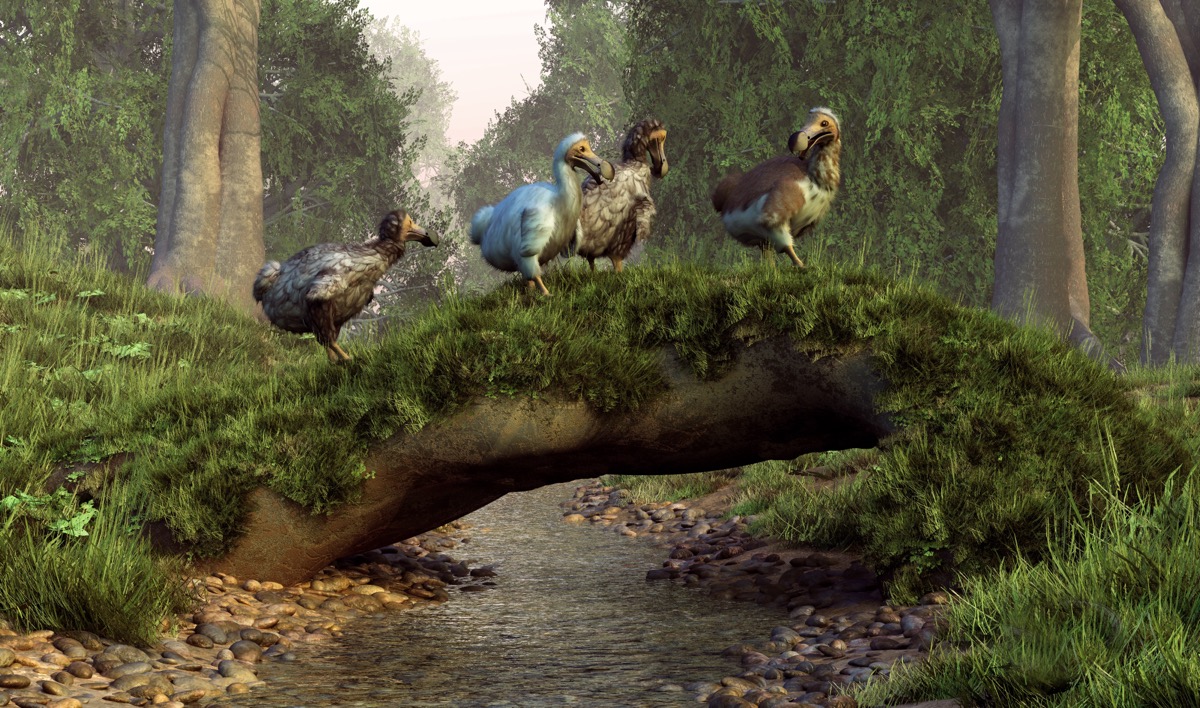
AI/CGI reconstruction of the dodo — based on skeletal data, feather fragments, and historical accounts.
The Bird
What Was the Dodo?
Raphus cucullatus was a large flightless bird endemic to Mauritius. Despite its unfamiliar appearance, it was closely related to pigeons and doves — a member of the family Columbidae. DNA analysis has confirmed this relationship, placing it closest to the Nicobar pigeon.
The dodo stood approximately 1 metre tall and weighed around 10–18 kg. It had blue-grey feathers, a large hooked beak, small stunted wings completely unable to support flight, and a tuft of feathers at the tail. Early Dutch accounts described it as plump and ungainly, but more recent skeletal analysis suggests the bird was reasonably agile and well-adapted to its environment.
Scientists now believe the dodo was not as unintelligent as the word “dodo” implies. It evolved in an environment with no natural mammalian predators and had no reason to fear approaching animals — a characteristic that sailors interpreted as stupidity but was simply the absence of learned fear.
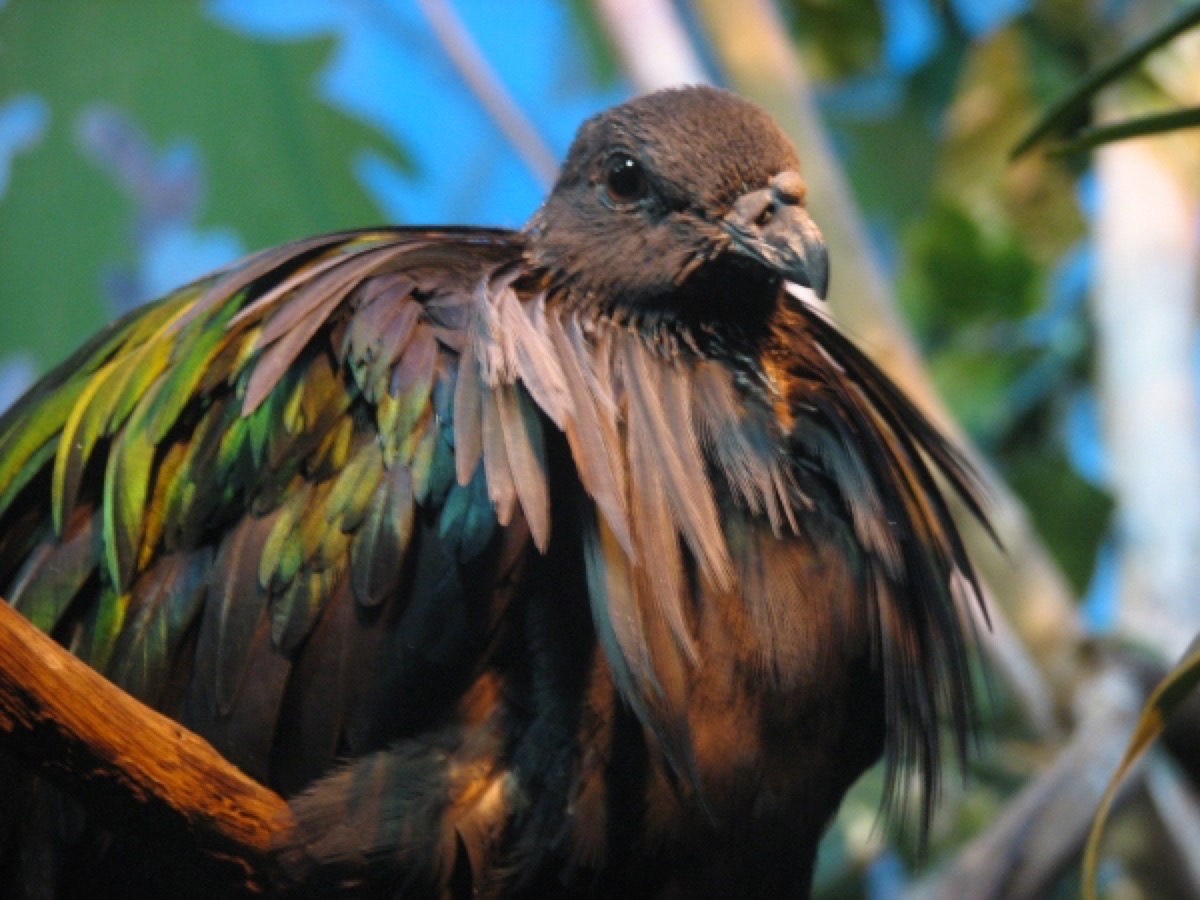
The Nicobar pigeon is the dodo’s closest living relative — a glimpse of what its ancestors once looked like
Fast Facts
These birds approached without any fear. They had never learned to be afraid of anything. They walked directly toward us — as if welcoming guests — and we seized them by hand.
Dutch sailor account — Mauritius, c. 1601

The Lost World
The tropical forests the dodo once called home
Evolution
Why Was It Flightless?
Mauritius had no native mammalian predators. The only land predators were large reptiles — and even these were rare. With no need to escape danger, flight became unnecessary — and, crucially, an evolutionary liability. Wings are metabolically expensive to maintain. Birds that didn't waste energy on flight had more energy for reproduction and foraging.
Over millions of years, the ancestors of the dodo — probably pigeon-like birds that colonised the island — lost the ability to fly. They nested on the ground, fed on fallen fruit, seeds and nuts, and lived in the dense tropical forests of Mauritius entirely untroubled by predators. The dodo had never needed to run, hide, or fear. When humans arrived with dogs, pigs, and rats, the bird had no evolved response to these threats.
This pattern — island species losing their defences in the absence of predators, then being devastated when predators are introduced — is called “ecological naivety” and has driven extinctions across island ecosystems worldwide.
1598
Discovery & First Encounters
Dutch sailors who arrived in 1598 described birds that were completely unafraid of humans — they walked directly up to the sailors, curious rather than fearful. The Dutch called them “dodaars” (fat-arse) or “walghvogel” (nauseating bird) — possibly because their meat was tough and unpleasant, though sailors ate them out of necessity when provisions ran short.
Early accounts describe the birds as docile, curious, and abundant. No observer at the time imagined the species would be gone within a human lifetime. Dodos were caught alive, held in cages, and brought back to Europe as curiosities — a few reached Amsterdam and were painted by Dutch artists, giving us our best visual record of the living bird.
c.1681
Extinction
The last widely accepted dodo sighting was recorded in 1662 by shipwrecked sailor Volkert Evertsz. The species was extinct by approximately 1681 — within less than 80 years of first European contact.
The primary causes were not hunting — the dodo's meat was reportedly unpleasant and was eaten mainly when other food was scarce. The real killers were the animals the Dutch introduced: pigs, rats, macaques, dogs, and cats. These predators ate dodo eggs and destroyed ground-level nests at a rate the birds could not survive. Habitat destruction as forests were cleared compounded the destruction.
The dodo had no evolved defences against any of these threats. It had never needed them.
Legacy
The Dodo in History
For over a century after its extinction, scientists debated whether the dodo had ever really existed. The accounts seemed too strange. The creature was dismissed as sailors' exaggeration. It was the discovery of dodo bones in the Mare aux Songes swamp in south-east Mauritius during the 1860s that proved the bird's existence definitively and triggered an international scientific reassessment.
The most famous dodo specimen — a desiccated head and foot from an animal kept alive in Europe — is held at the Oxford University Museum of Natural History. Lewis Carroll's Alice's Adventures in Wonderland (1865) featured a dodo: Carroll himself had a stammer and introduced himself to strangers as “Do-do-Dodgson.”
The dodo became, centuries before the modern environmental movement, the defining symbol of human-caused extinction. It gave the English language “dead as a dodo” and made the broader point — that species, once lost, are lost forever — long before conservation biology existed as a discipline.

The Blue Penny Museum, Caudan Waterfront, Port Louis — home to Mauritian historical artefacts including dodo records and the island’s colonial history
Today
The Dodo Today
The dodo is the national symbol of Mauritius, appearing on the national coat of arms. It is impossible to visit Mauritius without encountering dodo imagery — on souvenirs, signage, beer labels, and artworks.
More importantly, the dodo's story transformed Mauritius into a world leader in island conservation. The Mauritian Wildlife Foundation has brought the Pink Pigeon from 9 individuals to 500+, the Mauritius Kestrel from 4 individuals to 400+, and the Echo Parakeet from fewer than 20 to 750+ birds. These are among the greatest conservation success stories in history — and they are all explicitly motivated by the determination not to repeat the dodo's fate.
The lesson of the dodo is now understood as a lesson about invasive species — the rats, pigs, and monkeys introduced by humans were far more destructive than hunting. Modern Mauritian conservation focuses intensively on invasive species control, especially on offshore island sanctuaries.
Where to See Dodo Remains
Natural History Museum, Port Louis
The most complete dodo skeleton in Mauritius. Essential stop.
Mahebourg Historical Museum
Historical context, exhibits on the Dutch period and the dodo.
Blue Penny Museum, Caudan Waterfront
Historical artefacts and context within Port Louis heritage precinct.
Île aux Aigrettes
Not dodo remains, but this restored island shows the kind of ecosystem the dodo inhabited — giant tortoises, endemic plants, and conservation in action.
Explore More